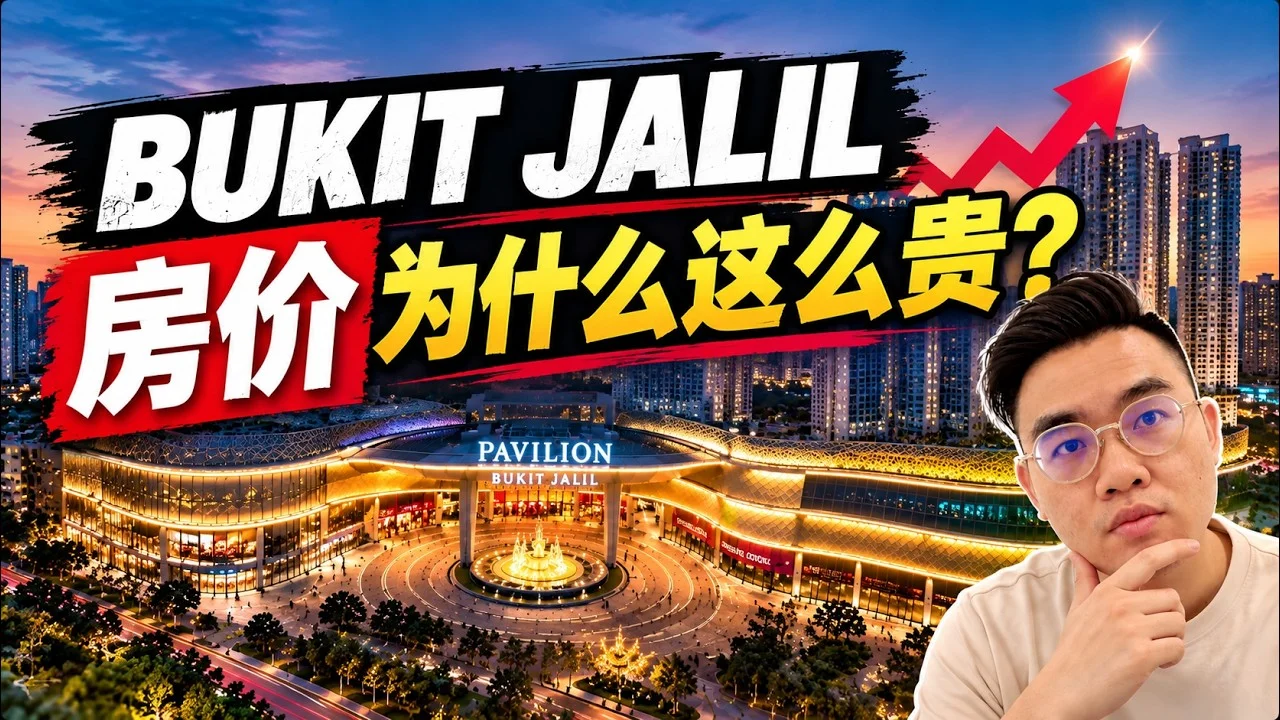
Bukit Jalil property isn't cheap anymore — and yet more buyers keep showing up, not fewer. Walk through Pavilion Bukit Jalil or the 80-acre recreational park on a weekend and you'll hear a noticeable amount of English, Mandarin and other foreign accents — MM2H retirees, investors, families relocating for the schools. Bigger units in the area's better-known projects have largely sold through. So the real question isn't whether Bukit Jalil is expensive. It's whether you're buying into a price that still has room to run, or into a bubble — and just as importantly, into the right pocket of a neighbourhood that is far less uniform than its name suggests.
Where Bukit Jalil sits, and how you actually get there
Bukit Jalil sits in southern Kuala Lumpur and has become one of the names that comes up whenever someone is house-hunting in KL's south — often described as "the next Mont Kiara." Three separate LRT stations serve it, and each one serves a genuinely different pocket:
- LRT Awan Besar — serves the Bukit Jalil City side: the Jalil Link commercial strip and the park-facing residential cluster.
- LRT Bukit Jalil — serves the National Stadium / sports-complex side, the station most people take to avoid traffic during concerts and matches.
- LRT Muhibbah — serves Kampung Muhibbah, a more industrial pocket on the other side of the neighbourhood.
So "Bukit Jalil has an LRT" is true, but it matters which station is actually near the project you're looking at. On top of that, MRT Taman Naga Emas on the Putrajaya Line runs directly to TRX — useful if you work in the city's financial district. By road, Bukit Jalil connects to the MEX Highway, Bukit Jalil Highway, KESAS and the LDP, giving reasonably direct routes to the KL city centre, Sunway, Puchong, Petaling Jaya and the airport.
An organised township, not just a postcode
Most residential areas start with housing, then slowly accumulate schools, clinics and shops around it. Bukit Jalil was built the other way — as an organised township where residential blocks, international schools, healthcare, a golf course, a major mall, an LRT line and a technology park all sit inside the same masterplan. That matters for property values because long-term rental demand and resale strength rarely come from one standout feature; they come from the whole ecosystem holding together. The sections below walk through each piece.
Lifestyle: Pavilion Bukit Jalil and an 80-acre park
Pavilion Bukit Jalil is one of the largest malls in the country, sitting right in the middle of the township. When it opened during COVID, plenty of people called it oversized for the area. Visit on a weekend now and the story is different — parking is hard to find, valet fills up, and traffic backs up onto the highway. A genuine tier-1 mall doesn't just add retail; it repositions the whole surrounding area, the same way Mid Valley lifted Seputeh and 1 Utama lifted Bandar Utama. Pavilion Bukit Jalil now functions as the commercial heart of KL's southern corridor.
The other anchor is the 80-acre Bukit Jalil Recreational Park — not a neighbourhood playground, but one of the largest city parks in KL. Genuine green space at this scale is increasingly rare: most new townships fill every available plot with condominiums. The land bordering this park is largely built out already, which means supply next to it is fixed while demand keeps arriving — a dynamic that has already played out at Desa Park City, where park-facing projects command a persistent premium. The Kuala Lumpur Golf & Country Club sits nearby too, and a golf course draws a specific kind of higher-income household that reinforces the area's overall quality and greenery.
Convenience and green space explain why locals and foreigners alike find Bukit Jalil an easy sell for family living. What pulls in wealthier households and international families specifically is the next two layers: education and healthcare.
Education: more than just international schools
Like Mont Kiara, Bukit Jalil has a strong line-up of international schools. But it has one card Mont Kiara doesn't: a well-regarded local Chinese primary school, SJK(C) Lai Meng. Plenty of families have moved to or rented in Bukit Jalil specifically to get their children into this school — which is part of why, until the recent wave of MM2H-driven foreign buying, the area's residents skewed heavily towards local Chinese families relocating for education.
On the international and tertiary side sit Tzu Chi International School, Asia Pacific University (APU), the International Medical University (IMU, which has produced a notable number of doctors), and the Australian International School Malaysia in nearby Seri Kembangan. That's a near-complete pipeline from primary school through to university. Since MM2H eligibility eased from 2024, a large wave of foreign buyers has moved in — and for expatriate and affluent families, having a full education pipeline already in place, alongside an established Chinese community, makes settling in immediately practical. Education has always been one of the hardest-edged drivers of property demand: strong schools draw wealthy families, and wealthy families support the price.
Healthcare: the reason I hold a position here myself
This is the piece I'd flag as the single biggest reason I've chosen to invest in Bukit Jalil myself. On the existing side, the nearest government hospital sits in Taman Desa, about 15 minutes away, and Columbia Asia Hospital already operates privately in the area.
The real changer is KL Wellness City, directly opposite Pavilion Bukit Jalil — billed as Southeast Asia's first integrated medical-health township. Its anchor, KL International Hospital, opens with 624 beds, expandable to 1,000, inside a project with an estimated GDV of around RM11 billion, phasing in progressively from late 2026 with medical suites, research labs, a wellness mall and even a retirement resort component.
This matters for property in two concrete ways. First, it directly answers the healthcare concern that MM2H retirees worry about most — Malaysia already runs 30-60% cheaper than the US, Europe or Singapore for comparable care, with English- and Mandarin-speaking doctors, and having that care inside your own township rather than a drive away removes the last real objection for a foreign retiree settling here. Second, a project of this scale brings in doctors, nurses, researchers and administrative staff — a steady base of higher-income tenants and buyers in their own right. Healthcare here isn't just a convenience; it's the next real growth engine for the area after Pavilion Bukit Jalil.
Employment: MRANTI Park
One piece reviewers of Bukit Jalil often skip, but shouldn't, is employment. MRANTI Park — formerly Technology Park Malaysia — is a 686-acre innovation park inside Bukit Jalil, already home to more than 150 tech companies and over 30,000 knowledge workers, with capacity planned for tens of thousands more and roughly 8,000 additional jobs expected across smart manufacturing, biotech, green technology and smart-city systems, plus a drone-testing zone, autonomous-vehicle lanes, a 5G hub and incoming data centres.
Why this matters for buying property: jobs create tenants, and higher-paying jobs create buyers. Bukit Jalil is often compared with Desa Park City on the basis that both are "lifestyle-led, without much Grade-A office nearby, yet command strong rents." That comparison holds — but Bukit Jalil has something Desa Park City doesn't: KL Wellness City and MRANTI Park layered on top of the same lifestyle draw. It isn't only pleasant, green and walkable — it also has a real, growing employment base and healthcare pipeline standing behind demand for the long run.
Price: Bukit Jalil versus Mont Kiara, and what actually happened to resale prices
Now, the numbers. Against Mont Kiara — using new-launch pricing as the benchmark — Mont Kiara averages roughly RM900-1,200 psf. Bukit Jalil's price varies hugely depending on exactly where you are: new launches in the city/Pavilion core run about RM800-1,100 psf, while outskirt zones run closer to RM600-800 psf. That's the whole explanation for why some people call Bukit Jalil expensive and others call it affordable — they're simply talking about different parts of it.
The most convincing evidence is the actual resale record from the city-core projects:
- Park Sky (Park 1) — completed 2019, launched around RM800 psf, now trading around RM1,000 psf on resale.
- Park 2 — completed 2021, launched around RM840 psf, now averaging around RM1,050 psf on resale (before legal fees).
- The Tropika — completed 2023, launched around RM750 psf during a soft MCO-era market, now around RM950 psf on resale.
That's a market-tested track record, not a marketing projection. Rental in the core has followed the same pattern — a fully furnished 3-bedroom unit around 900+ sq ft was renting for roughly RM3,500-4,000 a month as of 2026 in the city core, a level the outskirt zones simply haven't reached. And land in the core is genuinely running out: much of the walkable land around Pavilion Bukit Jalil has already been built on by projects like Kingswoodz, Queenswoodz and Park Green. With few remaining plots for another central-zone launch, and demand still arriving, that scarcity is a real factor behind the core's continued price strength — which is exactly why the difference between the core and the outskirts needs to be understood before you buy.
The part most reviews skip: Bukit Jalil is tiered, not uniform
This is the section that matters most, and the one that gets left out of most write-ups. A project carrying the "Bukit Jalil" name doesn't automatically give you the benefits described above. Bukit Jalil is genuinely tiered by location, and each tier has a different profile — even though the postal address looks the same.
- City / Pavilion core — the most walkable, most proven zone, home to Skyluxe, The Tropika, Park 1, Park 2 and The Treez. Historically the strongest rental demand and the resale track record above. The trade-off: highest density, the highest entry price, and the most traffic, since this is where the foot and car traffic concentrates.
- KL Wellness City zone — priced for potential rather than proof: existing projects here run roughly RM600-800 psf, betting on the area's value once Wellness City is fully operational. Today it isn't yet as walkable to Pavilion or the LRT, and has less greenery than the core.
- Kampung Muhibbah / family zone — the lowest entry price, suited to family buyers on a tighter budget who want more square feet for the money. Appreciation and rental have historically been softer than the core, and the immediate surroundings sit closer to industrial land, with a less "peaceful" feel.
- Golf course zone — a rarer landed-plus-golf combination, quiet and high-end. It suits affluent families buying to live rather than to maximise yield; rental demand here leans toward tenants who specifically want quiet, and returns depend heavily on entry price.
Put simply: buying "in Bukit Jalil" matters less than buying in the right zone of Bukit Jalil. The price gap between the core and the outskirts (roughly RM800-1,100 psf against RM600-800 psf) reflects a genuinely different rental and resale profile, not just a marketing difference.
The honest drawbacks
Two things worth being upfront about. First, traffic — Jalan Jalil Perkasa, especially the stretch near Jalil Link, genuinely jams during peak hours, and gets considerably worse around stadium concerts or matches; long-time residents know to avoid that stretch on event nights. Second, density — new towers keep going up, and most of what rings the park today is high-rise rather than landed housing.
Even so, rents in the core have kept climbing. That's because the ecosystem is complete enough that people keep choosing to move in anyway — Desa Park City runs the same playbook: heavy traffic at its limited entrances, yet people still pay a premium for the park, the international schools and the healthcare nearby. Bukit Jalil follows a similar script, with the added weight of KL Wellness City and MRANTI's job base behind it. The real question was never "does Bukit Jalil have drawbacks" — it does — but whether you've bought the right zone and the right project within it.
Joey's note: I've put together a full list of Bukit Jalil's current new-launch projects — organised by zone, with size, pricing and tenure — as a PDF. WhatsApp me and I'll send it over, along with a read on which zone actually fits your budget and goals (own stay with more space, investment yield, or a quiet owner-occupier hold).
Frequently asked questions
What are the different zones within Bukit Jalil?
Roughly four: the city/Pavilion core (most walkable, most proven, highest price and rent), the KL Wellness City zone (lower entry price, betting on the medical hub's completion), the Kampung Muhibbah/family zone (lowest entry price, closer to industrial land, larger sq ft for the budget), and the golf course zone (quiet, prestige, landed-plus-golf, priced for owner-occupiers more than yield).
What is MRANTI Park and why does it matter for Bukit Jalil property?
MRANTI Park (formerly Technology Park Malaysia) is a 686-acre innovation park inside Bukit Jalil, already home to over 150 tech companies and more than 30,000 knowledge workers, with roughly 8,000 further jobs expected across smart manufacturing, biotech, green tech and smart-city technology. More local high-income jobs support both tenant demand and buyer demand.
What is KL Wellness City?
KL Wellness City is billed as Southeast Asia's first integrated medical-health township, sited opposite Pavilion Bukit Jalil. Its anchor, KL International Hospital, opens with 624 beds (expandable to 1,000), as part of a project with an estimated GDV of around RM11 billion, phased in from late 2026 with medical suites, research labs, a wellness mall and a retirement resort.
How does Bukit Jalil's price compare to Mont Kiara?
Mont Kiara new launches average roughly RM900-1,200 psf. Bukit Jalil is not one price band — new launches in the city/Pavilion core run about RM800-1,100 psf, while outskirt zones such as areas near Kampung Muhibbah run closer to RM600-800 psf.
What LRT and MRT stations serve Bukit Jalil?
Three LRT stations, each serving a different pocket: LRT Awan Besar (Bukit Jalil City / Jalil Link commercial area), LRT Bukit Jalil (the National Stadium / sports precinct), and LRT Muhibbah (the Kampung Muhibbah / industrial side). MRT Taman Naga Emas, on the Putrajaya Line, connects directly to TRX.